
Ten minutes to eight weeks, depending on the path. Here’s the realistic timeline, and whether you’re actually covered while you wait.
Anywhere from about ten minutes to eight weeks, and which end you land on depends less on luck than on the path you take and how you prepare. If you’re asking because you have a deadline, here’s the realistic timeline, what slows things down, and the question almost nobody thinks to ask.
Two caveats on that table. “Time to decision” is not the same as “time to coverage” - more on that below. And guaranteed issue being instant is misleading: those policies typically carry a two-year graded death benefit, meaning death from natural causes in that window returns premiums rather than paying the face amount. Fast to issue is not the same as fast to protect.
Most people assume that signing the application means they’re protected. They aren’t. Coverage normally begins when the policy is issued, delivered, and the first premium is paid - which can be weeks after you applied.
The word doing the work is conditional. It generally pays only if underwriting determines you would have been insurable at the rate you applied for. If you would have been rated up or declined, the claim is denied and your premium is refunded to the beneficiary. Carriers also cap the temporary amount, and most exclude suicide during the period.
So it isn’t a policy, and it isn’t a guarantee. But for someone with a real gap in coverage right now, paying the first premium up front rather than waiting until approval can mean the difference between protected and not protected during those weeks.
Everything above is how the industry generally describes these timelines. Here is what happened in my own book, which is a smaller and more specific claim.
I went back through 24 cases placed in 2026 and measured one thing: days from submitted application to a carrier decision. Not to policy issue, not to the first premium, to a decision.
24 cases placed during 2026 by DG Life Group. A single practice, not an industry sample, and not a prediction of what your file will do.
Term cases ran a median of 4 days, and the handful that took two weeks or longer were the ones needing records from a physician, which matches everything in the section above about what actually causes delay.
In rough order of how often we see them:
A few common situations and what to expect:
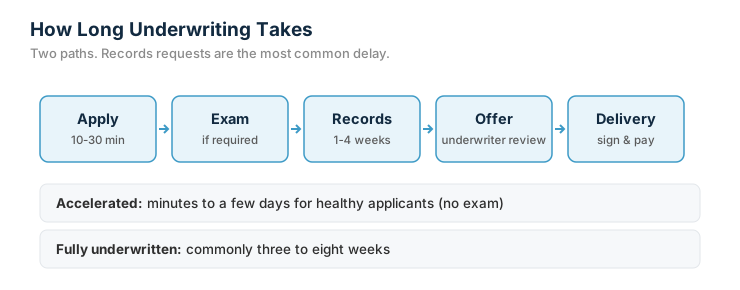
It depends on the underwriting path. Accelerated underwriting can approve a healthy applicant in as little as 10 minutes to a few days with no medical exam. Simplified issue typically takes a few days. Fully underwritten policies, which require an exam and often medical records, usually take three to eight weeks. Guaranteed issue is generally immediate but carries a graded death benefit for the first two years.
Accelerated (no-exam) underwriting is the fastest route for a healthy applicant under roughly age 60. The carrier verifies health electronically through prescription history, motor vehicle records and medical databases instead of ordering labs. Applying online, answering every question completely, and paying the first premium with the application all shorten the timeline further.
Sometimes, and this is the part most people do not know to ask about. If you pay the initial premium with your application, many carriers issue a conditional receipt or temporary insurance agreement that can provide coverage during underwriting. It is conditional: it generally pays only if underwriting determines you would have qualified at the rate applied for. If you would have been rated or declined, the claim is denied and premiums are refunded. Terms, limits and exclusions vary by carrier.
A conditional receipt is a temporary agreement issued when you submit an application together with the first premium. It can make coverage effective as of the date of the receipt or the medical exam, whichever the carrier specifies, provided you are eventually found insurable at the rate applied for. It is not a policy and not a guarantee of coverage. Most carriers cap the temporary amount and exclude suicide during the period.
The single most common delay is the Attending Physician Statement, where the carrier requests records from your doctor and waits on the doctor's office to send them. Other common causes are incomplete application answers, missed exam appointments, complex medical history, very large coverage amounts, and financial underwriting for business cases. Applying to a carrier that is a poor fit for your health profile also causes delays, because a decline means starting over.
Plan on several weeks unless you qualify for accelerated underwriting. Beyond the policy itself, the carrier must acknowledge the collateral assignment in writing, which adds time after approval. If you already own a policy with enough death benefit and remaining term, assigning it is often far faster than buying new coverage. Get the lender's requirement in writing early.
Coverage begins when the policy is issued, delivered and the first premium has been paid, unless a conditional receipt or temporary insurance agreement applies earlier. Submitting an application is not the same as being covered. Many people assume signing the paperwork means they are protected. Ask your advisor specifically when your coverage is effective, and get the answer in writing.
Industry timelines vary widely, so here is a specific figure rather than a range: across 24 cases placed by DG Life Group during 2026, the median time from submitted application to a carrier decision was 4 days, and 21 of the 24 were decided within a week. The fastest were final expense whole life cases, which decided in 0 to 1 day because simplified issue underwriting does not wait on medical records. The longest ran to 21 days, and those were files requiring records from a physician. This describes completed placements in one practice, not an industry average, and does not predict what any individual application will do.
It depends on whether you have a deadline. With a loan closing or a court-ordered requirement, speed can be worth paying more. Without a deadline, full underwriting often produces a better rate class, particularly if you have any health history, because labs and physician records give the underwriter evidence to justify better pricing. The fastest path and the cheapest path are frequently not the same one.
General insurance information on this page reflects standard industry practice. Texas policy forms and rates are filed with the Texas Department of Insurance; model regulations are maintained by the NAIC. Dev Gaymes is a licensed Texas producer, NPN 16654074, verifiable through the NIPR national producer database.
General education, not advice about your situation, and not an offer of insurance. Underwriting timelines, conditional receipt availability, temporary coverage limits and exclusions vary by carrier, product and state, and are governed solely by the terms of the issued documents. Nothing here describes any particular carrier’s current practices. All coverage is subject to carrier underwriting approval.