
A cardiac event sets a timeline and a price. It very rarely closes the door entirely.
Last reviewed October 2026 by Dev Gaymes, Texas-licensed life insurance agent, NPN 16654074 · Editorial policy
If you have had a cardiac event, you have probably already been told by a website that you are basically uninsurable, or been quoted a premium that felt like a penalty for surviving. Neither reflects how this is actually underwritten. A heart attack, stent or bypass does not take life insurance off the table. It sets a timeline and a price, and both are more workable than most people expect.
Carriers generally will not consider an application until enough time has passed to see how you have recovered. The wait varies by event:
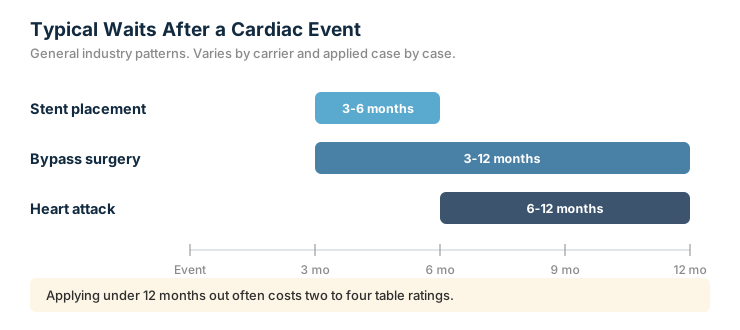
General industry patterns, not promises. Waiting periods vary by carrier, product and state and are applied case by case.
Ejection fraction measures how much blood your left ventricle pumps with each beat, and it is what underwriters look at first. A normal reading is generally 55% to 70%. Below about 50% is considered reduced, and lower figures move the assessment significantly.
Get this number from your cardiologist before you apply. Submitting without it forces the underwriter either to assume conservatively or to order the test themselves, which adds weeks to an already slow process.
This matters more on cardiac cases than almost anything else. An underwriter reading “I had a heart attack a couple of years ago” has to assume the worst plausible version. Give them the actual file:
Where a cardiac history is too recent or too severe for fully underwritten coverage, there are still options. They are simply more limited:
Usually yes, once enough time has passed. Carriers generally require a waiting period before they will consider an application, commonly six to twelve months after a heart attack, and some prefer longer. After that window they assess your current cardiac function rather than the event itself. Applicants who are stable, compliant with treatment and have good test results frequently qualify for table-rated coverage, and some reach Standard depending on severity and time elapsed. Very few people with a cardiac history are genuinely uninsurable.
It depends on the event. Stent placement commonly requires roughly three to six months, though many carriers prefer six to twelve. Bypass surgery generally runs three to twelve months, with longer waits after multi-vessel procedures. A heart attack typically requires six to twelve months, and some carriers want longer. If you are under twelve months out, waiting often improves your rating by two to four table ratings, which is real money every year for the life of the policy.
Ejection fraction measures how much blood your left ventricle pumps with each beat, and it is the single number underwriters focus on most. A normal reading is generally 55% to 70%. Below about 50% is considered reduced, and lower readings move the assessment significantly. Get your most recent echocardiogram result from your cardiologist before applying, an application without it forces the underwriter to assume the worst or order the test themselves, which adds weeks.
It cuts both ways, and the reason for the stent matters more than the stent itself. A stent signals that you had blockage significant enough to require intervention, which raises statistical risk. But successful treatment also demonstrates the problem was identified and addressed, which underwriters credit. A preventive stent generally receives more favorable treatment than one placed after a heart attack. Expect meaningfully higher rates than standard pricing, with the exact figure depending on time elapsed, ejection fraction and overall cardiac health.
Considerably. The difference between one affected artery and three is one of the larger factors in cardiac underwriting. Mild single-vessel disease managed with medication receives far more favorable treatment than severe multi-vessel disease requiring repeat intervention. Similarly, bypass with one graft is assessed differently from bypass with four, and having had both a bypass and subsequent stents indicates more extensive coronary disease, which typically means a higher rating.
Be specific. Underwriters want the month and year of the event, which arteries were involved, whether it was single or multi-vessel, exactly what treatment you received including the number of stents or grafts, whether there were any complications, your most recent ejection fraction, and your current medications. A vague answer forces conservative assumptions. Saying you had one drug-eluting stent placed in the LAD in March 2024 gives an underwriter something concrete to work with.
Traditional fully underwritten coverage is difficult with heart failure but not always impossible. Where ejection fraction remains above roughly 40% and the condition has been stable on medication for two or more years, some carriers will consider coverage at higher table ratings. Where that is not available, guaranteed issue policies remain an option. These require no health questions, carry a graded death benefit for the first two years, and are limited in amount, but they provide coverage that would otherwise be unavailable.
If you are less than twelve months from your event, waiting usually improves the outcome materially. If you are two or more years out and stable, apply now. Waiting past that point mostly makes you older, and age increases premiums permanently. It can also expose you to new health developments that complicate the file further. There is a point where continued waiting costs more than it saves, and for most stable cardiac applicants that point arrives around the two-year mark.
Rate classes, underwriting thresholds and policy provisions described here follow general industry practice; they are not any single insurer’s published guidelines. Life insurance rates in Texas are filed with and reviewed by the Texas Department of Insurance, which also handles consumer complaints and publishes company lookup tools. Model regulations governing policy provisions and advertising are maintained by the NAIC. Dev Gaymes is a licensed Texas producer, NPN 16654074, verifiable through the NIPR national producer database.
General education, not medical advice and not advice about your situation, and not an offer of insurance or a quote. Never change or stop any prescribed medication, or alter a treatment plan, without consulting your physician or cardiologist. Waiting periods, ejection fraction thresholds, table ratings and eligibility vary by carrier, product and state, change over time, and are applied case by case at the underwriter’s discretion. Nothing here describes any particular insurer’s current guidelines. All coverage is subject to carrier underwriting approval, and policy terms, benefits, exclusions and limitations are governed solely by the issued policy contract. Always answer every application question completely and truthfully.
Bring the dates, the procedure and your ejection fraction if you have it. We'll tell you where you're likely to land before you apply anywhere.
Prefer to talk now? Call 214-989-7704