
Real costs by age, policy types compared, and how to compare across 30+ carriers, so your family never has to worry about funeral costs.
Last reviewed November 2026 by Dev Gaymes, Texas-licensed life insurance agent, NPN 16654074 · Editorial policy
Final expense insurance, also called burial insurance or funeral insurance, is a small whole life policy designed to cover end-of-life costs. Coverage typically ranges from $5,000 to $50,000 and covers funeral and burial expenses, cremation, outstanding medical bills, and small debts. The premiums never increase, the coverage never expires, and the death benefit is generally paid to your beneficiary free of federal income tax. The National Funeral Directors Association’s most recent study, from 2023, put the national median for a funeral with viewing and burial at $8,300, or $9,995 with a burial vault, before cemetery costs, which is why many families choose $10,000 to $20,000 of coverage. (Source: National Funeral Directors Association, 2023 General Price List Study)
Most people weighing final expense are really choosing between four options, and three of them are cheaper.
General comparison. Pre-need contract terms, portability and price guarantees vary considerably by provider and state.
On saving instead: a dedicated account genuinely works if you have a decade and the discipline to leave it alone. It fails completely if you die in month four, and in practice it often fails anyway because something urgent comes up and the money goes. That is the honest case for insurance here - not return, but certainty and immediacy.
Monthly premiums for day-one whole life coverage - not graded - at Standard, non-tobacco, pulled September 2026.
Sample monthly premiums pulled September 2026 for a Texas applicant, representative of rates available across appointed A-rated carriers. Illustrative only - not a quote, not an offer of insurance, and not a guarantee of eligibility. Your premium depends on age, health, tobacco status, coverage amount, product and the carrier that underwrites your file. All coverage is subject to underwriting approval. These are day-one coverage rates. Graded policies with a two-year waiting period often price lower and are not equivalent.
According to the National Funeral Directors Association’s most recent study, from 2023, the national median cost of a funeral with viewing and burial was $8,300, or $9,995 with a burial vault. Those figures cover funeral home charges only, and prices have risen since. Here is how the main options compare:
Beyond the funeral, consider outstanding medical bills from a final illness, credit card balances, car loans, and other debts that don't disappear when you pass. Many families choose between $10,000 and $20,000 in coverage, enough to handle funeral costs plus a cushion for other expenses.
Not all burial insurance works the same way. The type you qualify for depends on your health, and the differences in cost and coverage are significant:
Health questions required (no exam). If approved, coverage starts immediately - no waiting period. Lower premiums than graded or guaranteed issue.
Best for: People in fair-to-good health who can answer health questions favorably.
Best ValueNo health questions, no exam. Acceptance is not based on health, within the carrier’s age limits. Includes a 2-year waiting period for natural death. Premiums usually well above simplified issue.
Best for: People with serious health conditions who've been declined elsewhere.
No Health QuestionsHealth questions required. A reduced payout in the first two or three years, then the full benefit; the schedule varies by carrier. Premiums between simplified and guaranteed.
Best for: People with moderate health issues who don't qualify for simplified but want more coverage than guaranteed.
Partial WaitAlways try simplified issue first. If you qualify, you pay less than for graded or guaranteed issue and are covered in full from day one. An independent broker can tell you which carriers are most likely to approve your specific health profile. What one denies, another often accepts. Talk to Dev for a free assessment →
Final expense premiums depend mainly on your age, health and the amount of coverage, and on the type of policy: simplified issue asks health questions, while guaranteed issue accepts anyone but pays a graded benefit for the first two to three years. Exact quotes for your age and amount are free.
| Feature | Simplified Issue | Guaranteed Issue |
|---|---|---|
| Health Questions | Yes (no exam) | ✓ None at all |
| Can You Be Denied? | Yes, based on health answers | ✓ No. Acceptance is not health-based |
| Waiting Period | ✓ None, immediate full coverage | 2-year waiting period |
| Monthly Cost | ✓ Lower | Higher |
| Coverage Amount | ✓ $5K–$50K | $5K–$25K typically |
| Death During Wait Period | ✓ Full benefit paid | Usually premiums refunded plus interest |
| Cash Value | Yes. Builds over time | Yes, builds over time |
| Best For | Fair-to-good health | Serious health conditions, prior denials |
Simplified issue policies accept many common conditions that people assume would disqualify them: Type 2 diabetes (controlled), high blood pressure, high cholesterol, history of heart disease (stable), COPD (mild-to-moderate), depression and anxiety, and prior cancer (in remission 2+ years). The key is that every carrier has different underwriting standards. What one declines, another may approve at standard rates. This is exactly where an independent broker with 30+ carriers makes the difference.
The conditions people most often assume rule them out, in my own files, are diabetes, kidney disease, a past heart attack or stroke, heart disease, and a poor driving record. None of them automatically means graded coverage. What decides it is how recent and how well controlled the condition is, and whose health questions you are answering, because each carrier asks different ones. A decline or a graded offer from one company tells you about that company, not about the market. Two of my own cases below show how far apart the answers can be.
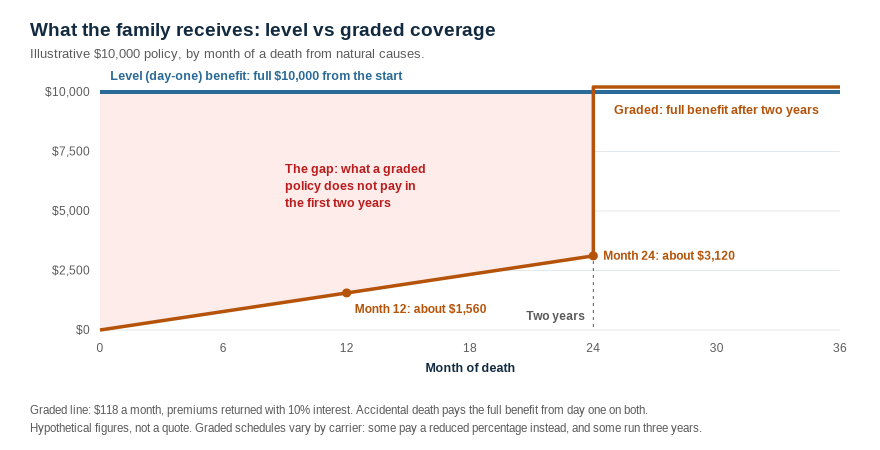
If you've been denied everywhere, guaranteed issue is your safety net. No health questions and no exam. Acceptance is not based on health. The 2-year waiting period means the policy returns premiums plus interest if you pass from natural causes in the first two years, but pays the full death benefit for accidental death from day one. After year two, full coverage kicks in regardless.
Among the cases I placed in 2026, every final expense application was decided the same day or the next, including applicants who had been declined elsewhere (the full casebook has the method and the limits). These two show what the shopping actually changes. Identifying details are left out.
He came to me after trying on his own. Every policy he tried either declined him or offered him graded coverage, and the graded offers topped out at $25,000. Stage 2 kidney disease reads very differently from one carrier's health questions to the next, so the work was finding the carrier whose questions he could answer cleanly.
He was approved for $50,000 with a level, day-one death benefit, issued the same day.
She already owned $30,000 of final expense whole life. Her goal had changed: she wanted to leave $10,000 to each of her grandchildren, which the policy she had could not do. Her back medication did not keep her out of full underwriting, and a death-benefit-focused indexed universal life policy with a no-lapse guarantee to age 121 doubled her coverage to $60,000 for the same premium. She canceled the whole life policy.
What she gave up was small in her case: the old policy was about a year old, had no meaningful cash value, and was still inside its own two-year contestable period. The new policy starts a new two-year contestable period, and the no-lapse guarantee holds only if she pays the premium it was designed around. Replacing a policy that has built cash value or is past contestability is a different decision, and one I would look at much harder.
Illustrative examples. The scenarios below are for illustration only and do not represent any specific client. Figures are hypothetical and are not a quote, an offer of coverage, or a prediction of results. Actual outcomes depend on age, health, carrier underwriting, and the terms of the issued policy.
Margaret's children were concerned about covering her funeral costs. She had a small savings but wanted to protect it for living expenses. She was quoted $92/month from a TV-advertised guaranteed issue plan for $15,000.
Her file could be run through simplified issue underwriting at several carriers. Because her health was good, she qualified for a $15,000 simplified issue whole life policy at $62/month - immediate full coverage, no waiting period. She saved $30/month ($360/year) and got better coverage than the TV plan.
James had been declined by two carriers due to his cardiac history plus diabetes. He assumed guaranteed issue was his only option. Some simplified issue carriers accept a stent placed more than two years earlier with controlled diabetes, so a file like his can qualify.
A file like his could be placed in a $12,000 simplified issue policy at $74/month with immediate coverage. The guaranteed issue alternative would have cost $105/month for $10,000 with a 2-year waiting period.
Dorothy's health conditions made simplified issue impossible. She'd been declined by 4 carriers. Guaranteed issue still accepts her: for example, a $10,000 guaranteed issue whole life policy at about $118 a month. No health questions, and acceptance was not based on her health.
The graded period needs to be explained clearly before she buys. Dorothy's daughter was named beneficiary. In the first two years, accidental death is covered in full; natural death typically returns the premiums paid plus interest, often 10% on the policies we see. After year two, the full $10,000 death benefit is active regardless of cause.
These are not the same thing. A pre-need plan is purchased directly from a funeral home and locks you into one specific funeral home and package. If you move or the funeral home closes, you may lose coverage. A final expense insurance policy pays cash directly to your beneficiary. They choose the funeral home, the arrangements, and can use remaining funds for anything. We usually recommend a final expense policy over a pre-need plan, for flexibility and portability. How religious customs change the timing and cost.
Final expense insurance is ideal when your primary goal is covering burial costs and small debts, typically $5,000–$25,000. If you need more coverage for income replacement, mortgage payoff, or family support, a term or whole life policy is the better fit. Many families combine both: a larger policy for income replacement plus a smaller final expense policy earmarked specifically for burial costs. Use our free calculator to determine your total coverage need.
Final expense whole life puts everyone who qualifies for the level benefit into one rate class. In fully underwritten whole life, indexed universal life or guaranteed universal life, those same people would land anywhere from Preferred to Table 4. At the same age and tobacco status, a healthy applicant pays the same final expense rate as someone with diabetes and high blood pressure. That pooling is a good deal for the second person and a poor one for the first.
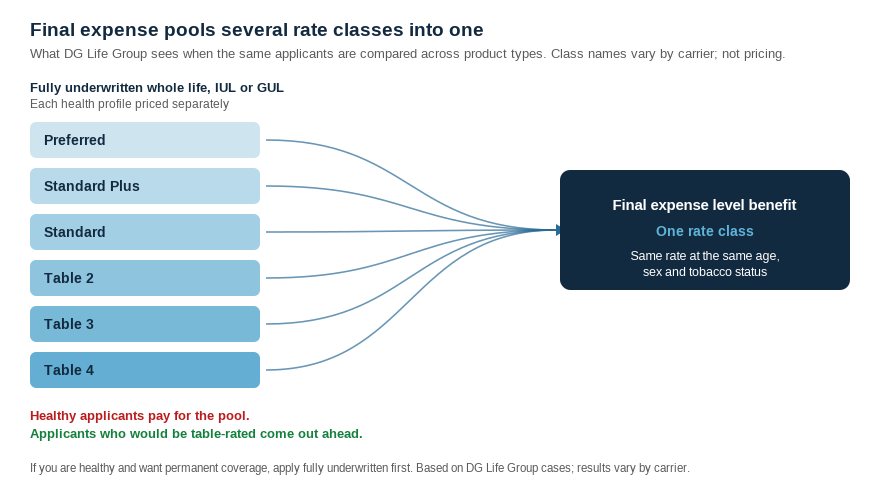
So if you are in good health and want permanent coverage, apply for fully underwritten coverage first and treat simplified issue as the fallback. Final expense earns its place when your health would put you in the bottom of those fully underwritten classes, or when you need coverage in days rather than weeks.
The clock starts when the company has the paperwork, not on the date of death. Families often expect the money within days of the death. The carrier cannot begin until it has the claim form and a certified death certificate, so ordering several certified copies early saves the family time.
Once it has them, Texas sets the pace: the company must pay the beneficiary within two months of receiving proof of death and verifying the beneficiary, and on an individual policy it owes interest on the benefit from the time it receives the proof of loss until it accepts the claim. Within that, some carriers are faster than others, and some will advance funds toward the funeral. That is worth asking about before you buy, not after.
Expect a longer review in the first two years. During the contestable period the company may review the application and the cause of death, and it can deny the claim if the application was wrong, even when the mistake was unrelated to the death or made innocently. If it denies, it must return the premiums. This is why I would rather spend an extra day getting a health answer exactly right than have a family find out about it at the claim.
Coverage Calculator - Add up debts, income, mortgage and education
Life Insurance Guide - Term vs. whole vs. universal compared by life stage
Living Benefits vs. LTC - Access your death benefit while alive for illness
Advance Planning - Wills, trusts, and legacy protection
Rate disclosure. Premiums shown are illustrative estimates for healthy non-smokers and are not a quote or an offer of coverage. Actual premiums depend on age, health, tobacco use, coverage amount, term length, state, carrier, and underwriting approval. Rates and product availability vary by carrier and by state.
Final expense insurance (also called burial insurance or funeral insurance) is a small whole life policy designed to cover end-of-life costs including a funeral (in the NFDA's 2023 study, the national median was $8,300 with viewing and burial and $6,280 with viewing and cremation, before cemetery costs), outstanding medical bills, and small debts. Coverage ranges from $5,000 to $50,000. The premiums never increase and the coverage never expires.
Simplified issue requires health questions (no exam) and offers immediate full coverage with lower premiums. Guaranteed issue has no health questions and no medical exam, making it ideal for people with serious health conditions, but includes a graded period of two to three years for natural death and usually costs more. If you can qualify for simplified issue, always choose it, better rates and immediate coverage.
Burial insurance is a type of life insurance. Specifically a small whole life policy with death benefits typically between $5,000 and $50,000. Unlike traditional life insurance designed to replace income, burial insurance is designed specifically to cover funeral costs and small end-of-life debts. It has simplified underwriting and is available to older applicants who might not qualify for standard life insurance.
Yes. Simplified issue policies accept many pre-existing conditions including diabetes, heart disease history, and COPD. If you are declined for simplified issue, guaranteed issue policies accept applicants within their age limits regardless of health, with no medical questions asked. The trade-off is a 2-year waiting period and higher premiums. An independent broker can compare how different carriers treat your specific health situation.
Final expense insurance is worth it if you want your funeral paid for without your family covering it. Without it, the cost lands on whoever is closest, and in the Federal Reserve's survey for 2025 only 63% of adults said they would cover even a $400 emergency expense with cash or its equivalent, let alone a funeral, which had a national median cost of $8,300 with viewing and burial in the NFDA's 2023 study. The premiums are locked, the coverage is permanent, and the death benefit is generally paid free of federal income tax. For seniors without sufficient savings earmarked for burial costs, it provides peace of mind.
The best age is as soon as you realize you need it. Premiums increase with every year you wait. Most people purchase final expense insurance between ages 50 and 75. A 55-year-old will pay significantly less than a 70-year-old for the same coverage. If you are under 60 and healthy, you may also qualify for a standard term or whole life policy at even better rates.
Often, yes. Diabetes, kidney disease, a past heart attack or stroke, heart disease and a poor driving record do not automatically mean graded coverage. What decides it is how recent and how well controlled the condition is, and which carrier's health questions you answer, since each carrier asks different ones. A decline or graded offer from one company says little about what another will do.
The timeline starts when the company receives the claim form and a certified death certificate, not on the date of death. In Texas, the company must pay within two months of receiving proof of death and verifying the beneficiary, and owes interest on an individual policy from receipt of the proof of loss until it accepts the claim. Claims in the first two years can take longer because the policy is still contestable.
