
Recovery is treated as an achievement by underwriters, not a permanent mark. Time and documentation are what move the rate.
Last reviewed September 2026 by Dev Gaymes, Texas-licensed life insurance agent, NPN 16654074 · Editorial policy
If you are in recovery and have been told you are uninsurable, that is usually wrong. Carriers underwrite substance use history the way they underwrite any other risk, by looking at what happened, how long ago, and what your life looks like now. Documented sobriety is an asset in this process, and the longer it runs, the more it is worth.
Everything else matters, but nothing matters as much as how long you have been sober and whether you can document it.
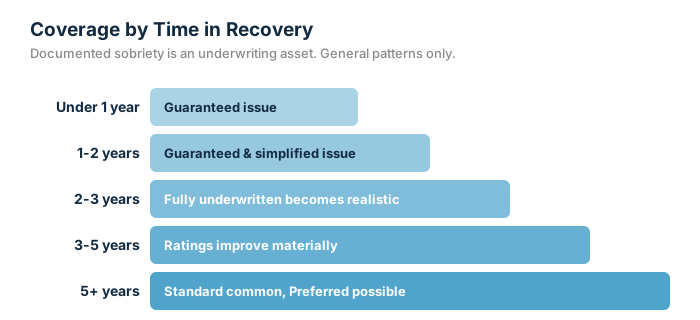
General industry patterns, not promises. Carriers vary widely on substance use history and apply guidelines case by case. Your own outcome depends on your full profile.
More than almost any other condition, this is a file where preparation changes the outcome. Underwriters are trying to assess stability, and stability has to be shown rather than asserted.
Substance use history is the category where carrier guidelines diverge most sharply. Some carriers require five years of sobriety before considering Standard; others will look at three. Some weight relapse history heavily; others focus on current stability. Some decline any DUI within five years; others assess it alongside everything else.
The same file, with the same sobriety date and the same records, can produce a decline at one company and a Standard offer at another. Rates are filed with state regulators, so the premium is identical whether you buy direct or through a broker. What changes is whether anyone matched your case to a carrier whose guidelines fit it.
Yes. Very few people in recovery are genuinely uninsurable. What changes is which products are available and at what price, and both improve with documented time. Early in recovery, guaranteed issue coverage is available with no health questions. After two to three years, fully underwritten coverage generally becomes realistic. After five years of documented sobriety, Standard rates are common and Preferred is possible with an otherwise strong health profile.
There is no single industry threshold, and carriers differ considerably. As a general pattern, fully underwritten coverage becomes realistic around two to three years, ratings improve materially between three and five years, and Standard rates are common past five years. Some carriers are meaningfully more accommodating than others at every one of those stages, which is why matching the file to the right carrier matters so much here.
Yes, always. Applications ask direct questions about alcohol use, substance use and treatment history, and failing to disclose creates a material misrepresentation that can allow a carrier to void the policy or deny a claim. Carriers verify through prescription databases, motor vehicle records, the MIB and medical records. The history surfaces regardless. Disclosing it yourself lets you present it in context, with documentation of recovery alongside it.
Yes, and it is checked directly through your motor vehicle record rather than relying on disclosure. A single DUI several years ago with a clean record since is often absorbed with a modest rating or none at all. A recent DUI, or multiple DUIs, weighs heavily and may result in postponement until more time has passed. Carriers vary in how far back they look, commonly three to five years for a recent offense.
A precise sobriety date, treatment records including programs completed and dates, evidence of ongoing counseling or support participation, current lab work particularly liver function, and your motor vehicle record. A short personal statement describing what changed also genuinely helps: underwriters are assessing stability, and a clear account of your current life provides context that records alone do not.
A decline is not permanent, and it is carrier-specific. Files involving substance use history often improve materially with time, continued sobriety and better documentation. It does create an MIB entry, so applying blindly to another carrier is not the right next step. Understanding why the decline happened, and how much has changed since, is what prevents a second one.
Yes, though they are limited. Guaranteed issue policies require no health questions and are available regardless of substance use status - coverage is capped, premiums are higher per dollar of benefit, and there is typically a graded death benefit for the first two years. Employer group life coverage, where available, also generally requires no individual underwriting. Neither is ideal, but both provide real coverage, and neither prevents you from applying for better coverage later.
It helps. Documented participation in treatment and aftercare is evidence of active management, which is exactly what underwriters are assessing. Some applicants worry that acknowledging a program draws attention to the history, but the history is already visible through other records, and the program is the part that demonstrates stability. Recovery is treated as an achievement in this process, not as a red flag.
Rate classes, underwriting thresholds and policy provisions described here follow general industry practice; they are not any single insurer’s published guidelines. Life insurance rates in Texas are filed with and reviewed by the Texas Department of Insurance, which also handles consumer complaints and publishes company lookup tools. Model regulations governing policy provisions and advertising are maintained by the NAIC. Dev Gaymes is a licensed Texas producer, NPN 16654074, verifiable through the NIPR national producer database.
General education, not medical advice and not advice about your situation, and not an offer of insurance or a quote. Never change or stop any prescribed medication, or alter a treatment plan, without consulting your physician. Underwriting guidelines, including thresholds, waiting periods and rate classes, vary by carrier, product and state, change over time, and are applied case by case at the underwriter’s discretion. Nothing here describes any particular insurer’s current guidelines. All coverage is subject to carrier underwriting approval, and policy terms, benefits, exclusions and limitations are governed solely by the issued policy contract. Always answer every application question completely and truthfully.
Bring your sobriety date, treatment history and current health picture. We'll tell you honestly what's available at this stage.
Prefer to talk now? Call 214-989-7704